

ViewMatrix Digital — Singapore
How websites and apps get built
A plain-language starting point for Singapore businesses: what happens between an idea and a working website or mobile app, and how to ask better questions at every stage.
Who this is written for
Owners, operations, marketing
ViewMatrix Digital is an information resource for Singapore businesses that want to understand what happens between an idea and a working website or mobile app. We write in plain language. We don't sell income projections, and we don't promise that any single tool will solve a business problem on its own. What we do is explain how projects are actually planned, designed, built, and kept running, so you can ask better questions when you talk to a development team.
The material here is written for owners, operations managers, and marketing staff at small and mid-sized companies. Most of our readers are not developers. They need enough vocabulary to compare options without getting buried in jargon. If a term shows up a lot in agency proposals, it usually appears here too, with a short explanation of what it means in practice.
Choosing the wrong category of project is the most common reason a build runs long.
A brochure site, a single-action landing page, and a custom web app are three different jobs with three different budgets of time and money. Getting that decision right at the start saves the most work later.
Start with the job, not the technology
We cover all three shapes on separate pages, because the trade-offs are not obvious from a proposal document. A five-page site and a customer portal can both be described as web development, yet they involve very different planning, testing, and maintenance work.
-
A business website
Tells visitors who you are, what you offer, and how to reach you. Usually a handful of pages with contact details, service descriptions, and location information. The work is mostly structure, writing, and consistent design rather than custom logic.
Websites & Web Apps -
A landing page
Focuses on one action, such as a booking or a form submission. Fewer pages, tighter writing, and more attention paid to how the page reads on a phone. Often used alongside a campaign rather than as the main site.
Design & UX -
A custom web application
Does work: it manages bookings, calculates quotes, tracks inventory, or connects to systems your staff already use. This is where role-based access, data rules, and API integration decide most of the schedule and most of the cost.
How We Work

Where Singapore's market sits
The local market is crowded. You can hire a solo freelancer, a small studio, a regional delivery firm, or an in-house team. Each option has a different cost profile and a different level of continuity after launch. Small studios often move faster on discovery and stay closer to the original brief. Larger firms bring more process and more people, which helps on complex integrations but slows down small changes.
The practical questions are usually about fit rather than size. Does the team understand your sector? Can they show how they handle data from an existing system? Will the same people be around in a year? Our pages on platforms, maintenance, and mobile apps exist to make those questions easier to ask.
Questions worth asking
- Who will do the discovery work, and how long do they expect it to take?
- How is data moved from any system you already run?
- What is handed over at launch — access, documentation, source?
- Who is responsible for updates in month three, and in year two?
What platforms actually do
None of these tools is universally better. The right pick depends on what you're building, who will maintain it, and how it needs to connect to other systems. This list covers the names that appear most often in proposals for Singapore businesses.
Compare platforms and frameworks- WordPress
- A content management system that stores your pages and lets non-technical staff edit them. Open source since 2003 and widely used for business sites and blogs, partly because updates and small changes are straightforward.
- Drupal
- Handles complex content structures and permissions, which is why it still appears on public-sector and information-heavy sites with many editors.
- Strapi
- A headless CMS: it stores content and delivers it through APIs to a website, a mobile app, or both at once.
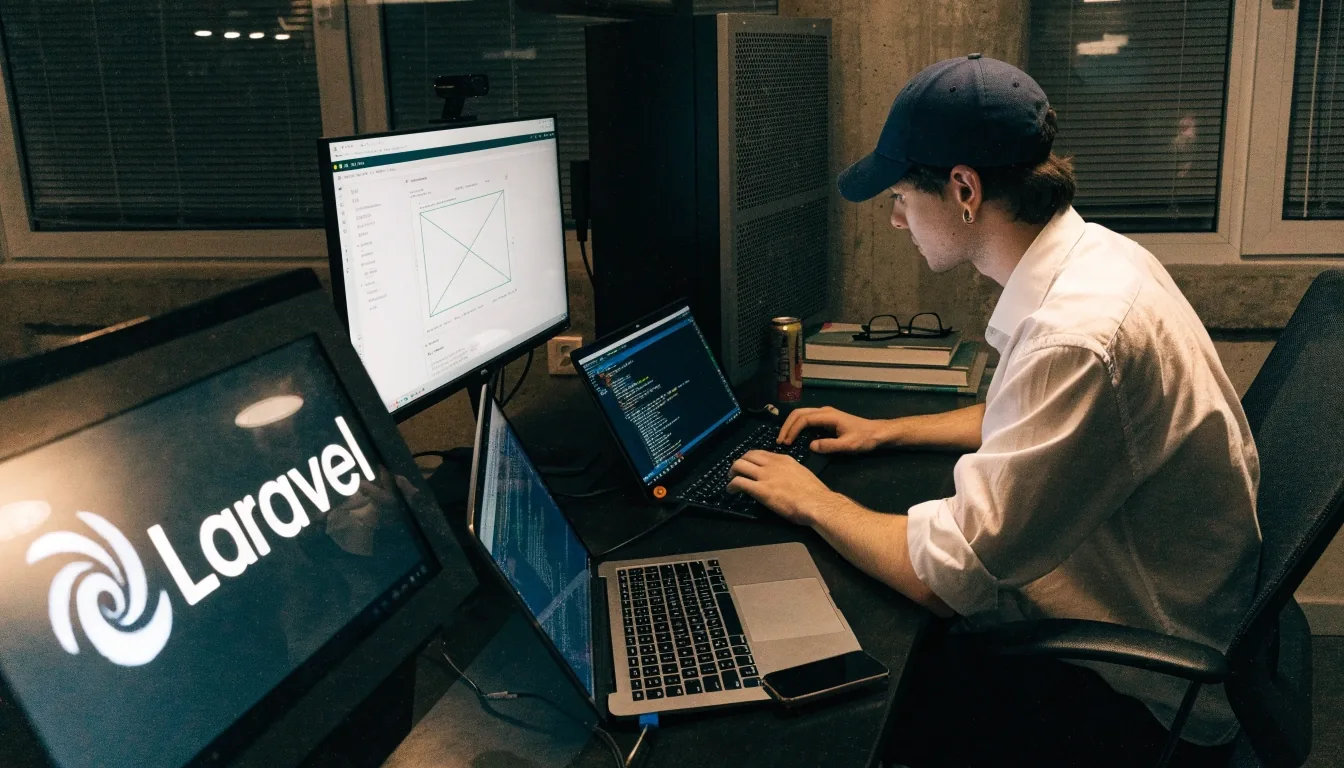
- Laravel
- A PHP framework known for clean structure and built-in authentication tools, often chosen for custom web applications.
- Django
- A Python framework with strong conventions and an admin interface included, useful when a team needs to manage data behind the scenes.
- Next.js
- Builds on React and supports server-side rendering, static generation, and hybrid approaches, which matters when search visibility and page speed are priorities.
- Vue.js
- A lighter front-end framework often used for dashboards and internal tools where the interface changes often.
- Figma
- Where wireframes, UI design, and clickable prototypes are usually made before any code is written.

Design before development
Wireframes and prototypes are not decoration. They are how a team checks that a layout makes sense before spending weeks on code. A clickable prototype in Figma lets you test a booking flow or a checkout sequence while changes are still cheap. Design systems, which are reusable sets of components, keep a site consistent as it grows and make later additions faster.
Responsive design belongs to this stage, not a final polish step. Most visitors in Singapore reach business sites on a phone, so layouts need to work on small screens from the first draft.
See how design and UX are handledWhat happens after launch
Launch is a milestone, not the end of the work. Hosting, backups, security updates, and monitoring continue. Frameworks and CMS platforms release updates regularly, and skipping them creates risk. Maintenance also covers small improvements: a new form field, a revised page, a performance fix.
Our maintenance page explains what a support arrangement usually includes, and which parts you can handle in-house with the right access and documentation.
See what maintenance covers-
1
Handover
Access to hosting, the CMS, and any third-party services is transferred or documented, along with the notes needed to make routine changes.
-
2
Updates and backups
Platform and framework updates are applied on a schedule, and backups run often enough that a failed update can be reversed without losing content.
-
3
Monitoring and reporting
Uptime checks and a clear route for reporting issues. Ask who receives the alert, and what happens outside working hours.
-
4
Small improvements
A new form field, a revised page, a performance fix. These requests are easier to plan when someone already knows the codebase.
How to read this site
You can read the pages in any order, but the sequence below works well if you're starting from scratch. Each step answers one question before the next one becomes useful.
Step one
Decide the category
Website, landing page, or web app. This choice shapes everything downstream.
Websites & Web AppsStep two
Understand the tools
Platforms and frameworks, and what each one is usually chosen for.
Platforms & FrameworksStep three
See the design stage
Wireframes, prototypes, design systems, and responsive layouts.
Design & UXStep four
Add mobile if needed
When a phone app makes sense, and when a responsive site is enough.
Mobile AppsAnd then keep it running
The final step is maintenance, which is where the long-term picture lives: what a support arrangement covers, and what you can handle in-house.
Maintenance & SupportA note on what we don't do
We don't publish client testimonials, ratings, or case studies with performance figures, because we can't verify them to a standard we'd be comfortable with. We also don't claim that any framework, CMS, or design approach guarantees a business outcome. What we can do is describe how the work is usually done, and what to watch for at each stage.
That is also why you won't find income projections or cost promises on these pages. Every project has its own scope, and the honest answer to "how much will this cost" starts with a conversation about what the software has to do.
Common questions
Short answers to the questions readers send most often. If yours isn't here, the contact page has our email and working hours.
How do I choose between a website builder and a custom web app?
A builder suits a brochure site with standard pages and forms. A custom web app suits workflows that a builder can't handle, such as role-based access, calculations, or connections to existing business systems. If your requirements fit inside a template, a builder is usually faster and cheaper.
How long does a typical project take from discovery to launch?
It depends on scope. A small business website is measured in weeks. A custom web application or a mobile app usually takes several months, because discovery, design, build, and testing each take time. The how we work page breaks the stages down.
Which CMS is best for a business website in Singapore?
There's no single answer. WordPress is common for sites that need frequent content updates with lower maintenance complexity. Drupal suits large sites with many editors and strict permissions. Strapi fits projects where content also feeds a mobile app.
What should maintenance and support include?
At minimum: software updates, backups, uptime monitoring, and a route for reporting issues. Many teams also handle small content changes and performance checks. Ask who is responsible for each item and how response times are defined.
Have a question that isn't covered here?
Send us a short description of what you're trying to build. We'll point you to the pages that apply, or answer directly if the answer is short. We reply Monday to Friday, 9:00 AM – 6:00 PM.
- [email protected]
- Phone
- +65 6210 8789
- Working hours
- Monday to Friday, 9:00 AM – 6:00 PM